
Dr. Vishal Kundnani
MS (Ortho) FASSI, FNUS, FNAMS.Dedicated spinal fusion specialist and spine surgeon in Mumbai.


Spinal Fusion, MIS-TLIF & Spinal Decompression
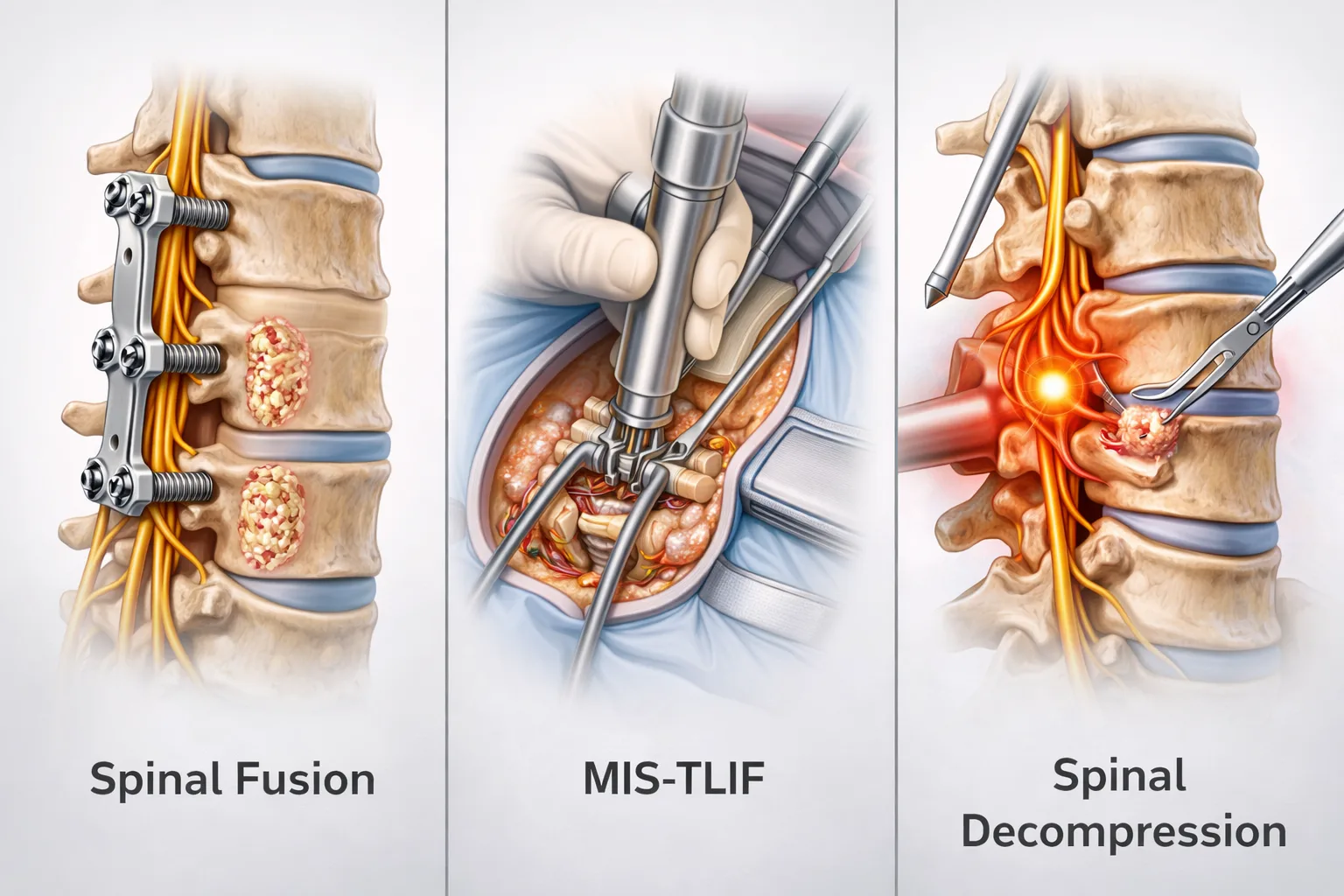
Spine surgery terms like fusion, decompression, and MIS-TLIF can sound frightening to patients.
This guide answers the most common patient questions in a clear, honest, and reassuring way to help patients make informed decisions.
SPINAL DECOMPRESSION SURGERY – FAQ
1. What is spinal decompression surgery?
Spinal decompression surgery relieves pressure on spinal nerves caused by disc herniation, spinal stenosis, or bone overgrowth.
2. Why is spinal decompression needed?
It is done to relieve:
- Leg pain (sciatica)
- Numbness or weakness
- Difficulty walking
- Nerve compression pain
3. What conditions need decompression surgery?
Common conditions include:
- Slipped (herniated) disc
- Lumbar canal stenosis
- Cervical stenosis
- Nerve root compression
4. What types of decompression surgery are there?
- Discectomy / Microdiscectomy
- Laminectomy
- Laminotomy
- Foraminotomy
5. Is decompression surgery a major surgery?
Most decompression procedures today are minimally invasive and considered safe and routine when done by experienced spine surgeons.
6. How effective is spinal decompression surgery?
Success rates are high (80–95%) for properly selected patients, especially for leg pain and nerve symptoms.
🔹 SPINAL FUSION SURGERY – FAQ
7. What is spinal fusion surgery?
Spinal fusion permanently joins two or more vertebrae to stop painful movement and stabilize the spine.
8. Why is spinal fusion done?
Fusion is done for:
- Spine instability
- Severe disc degeneration
- Spondylolisthesis
- Deformity or recurrent disc problems
Spinal fusion is also commonly used in scoliosis surgery to correct spinal deformities.
9. Does spinal fusion mean loss of movement?
Movement at the fused level is lost, but most patients do not notice significant restriction in daily activities.
10. Is spinal fusion always required with decompression?
No. Fusion is needed only when:
- There is instability
- Significant slip or deformity exists
- Decompression alone may worsen instability
11. How long does spinal fusion surgery take?
Typically:
- 2–4 hours
- May vary depending on complexity
12. How long does fusion take to heal?
Bone fusion usually takes:
- 3–6 months
- Full strength may take up to 12 months
🔹 MIS-TLIF (MINIMALLY INVASIVE TLIF) – FAQ
13. What is MIS-TLIF surgery?
MIS-TLIF (Minimally Invasive Transforaminal Lumbar Interbody Fusion) is a modern fusion technique done through small incisions with minimal muscle damage.
14. Why is MIS-TLIF preferred over open fusion?
Benefits include:
- Smaller incision
- Less blood loss
- Less pain
- Faster recovery
- Shorter hospital stay
15. Who is a candidate for MIS-TLIF?
MIS-TLIF is suitable for patients with:
- Slip disc with instability
- Spondylolisthesis
- Failed conservative treatment
- Recurrent disc herniation
16. Is MIS-TLIF safer than open spine surgery?
Yes. When performed by trained surgeons, MIS-TLIF is as effective and often safer than open surgery.
17. How long is hospital stay after MIS-TLIF?
Usually:
- 2–4 days
- Some patients walk the same day or next day
18. How soon can I return to work after MIS-TLIF?
- Desk work: 2–4 weeks
- Physical work: 6–12 weeks
🔹 COMMON PATIENT CONCERNS
19. Will spinal fusion or MIS-TLIF completely cure my pain?
- Leg pain usually improves significantly.
- Back pain improves gradually and depends on rehabilitation and lifestyle changes.
20. When should surgery not be delayed?
Do not delay surgery if:
- Pain is worsening
- Weakness or numbness increases
- Walking becomes difficult
- Bladder or bowel symptoms appear
Call to Action
Early diagnosis and choosing the right surgery for the right patient leads to excellent outcomes and faster recovery. Learn more about our physiotherapy and rehabilitation services. Consult Dr. Vishal Kundnani at Bombay Hospital or Lilavati Hospital in Mumbai for expert evaluation. Book your consultation today.
Medical Disclaimer
⚠️ This content is for educational purposes only and does not replace consultation with a qualified spine specialist.

